

Upgrade Your Cooking Oils: What I Use for High-Heat, Dressings, and Baking
When you’re building an intentional kitchen that supports your health goals, every ingredient matters — but so does every product. One of the most overlooked ways to elevate both your cooking and your space? Upgrading your oils.
We all use them daily, even — but it’s easy to fall into the habit of whatever’s cheapest or most convenient. — They affect our health, energy, and even progress with weight loss. Low-quality oils are often highly processed, inflammatory, and calorie-dense, with little nutritional value. Compared to proteins or complex carbs, fats pack in more than twice the calories per gram, which means that even small amounts of poor-quality oils can quietly derail your health and weight-loss goals. I hope you already know that seed and vegetable oils are highly processed and bad for your health — the biggest downside of choosing the wrong cooking oil is increased inflammation in the body. That’s why I stick to a short list of the healthiest oils and rotate between them.
This post isn’t about the deep nutritional science (though I do love that side). This one’s about practical upgrades — how the oils you use (and how you store them) can quietly transform your kitchen into a space that supports ease, style, and nourishment.
To keep cooking simple and easy, you really need just two types of oils: a cooking oil that can stand high heat without becoming toxic, and a light oil that’s perfect for salad dressings or drizzling over food. Here are the three essentials I keep in my kitchen.
1. For High-Heat Cooking: Avocado Oil
If you sauté, roast, or stir-fry regularly, you need a high-smoke-point oil. Avocado oil is neutral in taste, naturally abundant in healthy fats that we all seek, and can maintain stability at high temperatures — up to 520°F (271°C), the highest smoke point of all the oils here — without breaking down its molecules, remaining safe without becoming toxic. It’s high in monounsaturated fats and vitamin E, which help reduce bad cholesterol (LDL), and its neutral taste makes it versatile for searing, grilling, and roasting.
How I Use It:
Why It’s an Upgrade:
Fun fact: If you cook onions in avocado oil, your onions will turn green
📦 Amazon Pick: Chosen Foods Avocado Oil – Cold-Pressed
2. For Dressings & Drizzling: Extra Virgin Olive Oil (EVOO)
EVOO is one of those kitchen staples that feels elevated even before you open it. It’s rich in antioxidants and healthy monounsaturated fats, with anti-inflammatory properties that support heart health and brain function. I use it in salad dressings, dips, and to finish cooked dishes with a bit of drizzle — use it raw for maximum benefits. For mild heat under 375°F (190°C), a light olive oil works well; save your extra virgin for cold dishes.
How I Use It:
Why It’s an Upgrade:
📦 Amazon Pick: Kirkland EVOO
3. For Baking or Occasional Rich Flavor: Ghee or Coconut Oil
Forget about cooking with butter, we have healthier and more delicious options. Ghee and Coconut oil. There’s something cozy about using ghee or coconut oil — they bring warmth, a little indulgence, and depth of flavor. These aren’t everyday oils in my kitchen, but I keep them stocked for occasional banana bread.
Ghee is high in fat-soluble vitamins A, D, E, and K, contains butyrate which supports gut health, and has a high smoke point of 485°F (250°C) — perfect for high-heat cooking, frying, sautéing, roasting, and even baking. It’s also lactose- and casein-free, which makes it easier to digest for many people, and it adds deep, rich flavor to dishes.
Coconut oil contains medium-chain triglycerides (MCTs), which support metabolism and brain function, and has antimicrobial properties that help reduce harmful bacteria. It’s stable for baking, stir-frying, and sautéing at moderate heat — around 350°F (177°C) — works well in almost any dish, sweet or savory, and is an excellent alternative for dairy-free and vegan recipes. I don’t usually bake, but I use coconut oil when I do.
How I Use Them:
Why It’s an Upgrade:
📦 Amazon Picks:
If your goal is to lose or maintain body weight, be mindful of the amount you use — all oils are high in calories. These are healthy fats, so I wouldn’t be concerned about the fat content, but watch the quantity if weight gain is a concern.
A Note on Storage: Function Meets Aesthetic
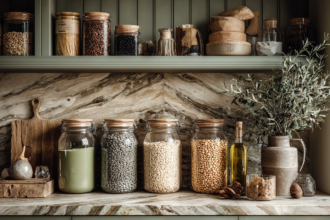
If you’ve seen my pantry, you know I love a calm, intentional space. That extends to oils, too. I decant my olive oil into a small dispenser I keep by the stove on a flat marble tray, and store larger refill bottles in the pantry, always away from light and heat.
Little upgrades make a big difference. When oils are easily accessible, stored beautifully, and chosen with purpose, they become more than just pantry staples. They become kitchen allies.
Increase Your Knowledge: A Book Worth Reading
If you want to go deeper on healthy fats, I recommend Eat Fat, Get Thin by Dr. Mark Hyman — it explains why the fat we eat is the key to sustained weight loss and vibrant health. There’s also a companion cookbook with more than 175 delicious recipes.
A Small Change That Changes Everything
Upgrading your cooking oils doesn’t mean filling your pantry with trendy ingredients; these are traditional classics that many cultures have been using for years. It means choosing high-quality basics that serve your life, whether you’re cooking for your kids, batch-prepping for the week, or making something simple and nourishing just for yourself.
These oils cover all your cooking needs — there’s no need to clutter your kitchen with unhealthy, processed oils. Choose one cooking oil and one light oil that best fits your cooking style: ghee or avocado oil is excellent for high-heat cooking, olive oil is great for dressings and drizzling, and coconut oil is a great alternative when you need extra versatility. Currently, I have olive oil and ghee in my kitchen, and I buy in large quantities at Costco or from Amazon to save time.
If you’re rethinking your kitchen setup, this is an easy and impactful place to start.
Start with one bottle. Your meals will taste better. Your space will feel calmer. And over time, these little upgrades create significant change.