
Why the Entryway Deserves Its Own Plan
Every December, we notice the same thing: the living room gets the tree, the dining room gets the tablescape, and the entryway — the very first thing every guest sees — gets whatever is left over. A tired wreath. A bowl of ornaments we did not know what to do with. For years, ours looked like an afterthought, and it showed in how the whole house felt when you walked in.
Here is what we have come to believe: the entryway is not a hallway you decorate. It is a greeting. It sets the emotional temperature of your home before anyone has taken off their coat. When it is calm, warm, and intentional, guests relax the moment they cross the threshold. When it is cluttered or shouting with too much red and glitter, the whole evening starts on a slightly frantic note.
So we started treating the foyer like its own small room with its own small plan. What follows is exactly how we style ours now — the palette, the pieces, and the restraint that keeps it elegant instead of exhausting.
The Palette: Warmth Without the Tinsel
Before we buy or unpack a single decoration, we decide on the palette, and we do not deviate. For an elegant Christmas entryway, we stay inside a tight family of colors: warm gold, brushed bronze, deep emerald, rich burgundy, and warm browns. These are the colors of candlelight and fireplaces, of velvet and aged wood. They photograph beautifully, they flatter every skin tone in the doorway light, and they never look dated in January photos.
What we deliberately leave out: bright primary red, neon-bright green, icy silver-blue, and anything that looks like it belongs in a shopping mall atrium. There is nothing wrong with a classic red Christmas — it simply is not this Christmas. Restraint is the entire aesthetic. When everything in the entryway belongs to the same warm family, even inexpensive pieces look curated.
A practical tip we swear by: hold every candidate decoration next to a lit candle before it earns a place. If it looks harsh or plastic in candlelight, it will look harsh in your entryway. Candlelight is the truest test we know.
Start at the Door: The Wreath
The wreath is the handshake of your home, so we give it more thought than anything else in the foyer. Our formula has not changed in years: a generous natural greenery wreath — cedar, pine, or a mix — with almost nothing on it. A wide velvet ribbon in deep burgundy or forest emerald, tied in a loose bow at the top or bottom, is all the adornment it needs.
What makes a wreath look expensive is fullness and freshness, not ornaments. If you are buying artificial, choose one where you can see individual branch tips rather than a solid wall of green; fluff it for a full ten minutes before hanging, because manufacturers ship them compressed and most people never open them up. If you are buying fresh, keep it out of direct sun and give it a light misting of water every few days — a fresh wreath by the door can easily last the whole season.
Hang it with a simple brass or bronze hook rather than a plastic over-the-door hanger if you can. It is a small detail, but the metal reads as intentional where plastic reads as temporary.
The Garland, Done With Intention
Garland is where entryways usually go wrong — too much of it, hung too symmetrically, looking like a frame rather than a gesture. We use one garland, and we place it where it will be seen in the round: either draped along the stair railing or laid across the console table as a runner.
The trick is asymmetry. Let one end hang lower than the other. Tuck in a few stems of eucalyptus or dried orange slices for texture. Weave in warm-white fairy lights — never cool white, which turns greenery a sickly blue-green after dark — and keep the light count modest. You want a glow, not a landing strip.
If your entryway has a staircase, resist the urge to swag every baluster. Three generous swags, tied with velvet ribbon at intervals, look far more elegant than a continuous drape. Negative space is a design choice, not an absence.
The Console Table Vignette
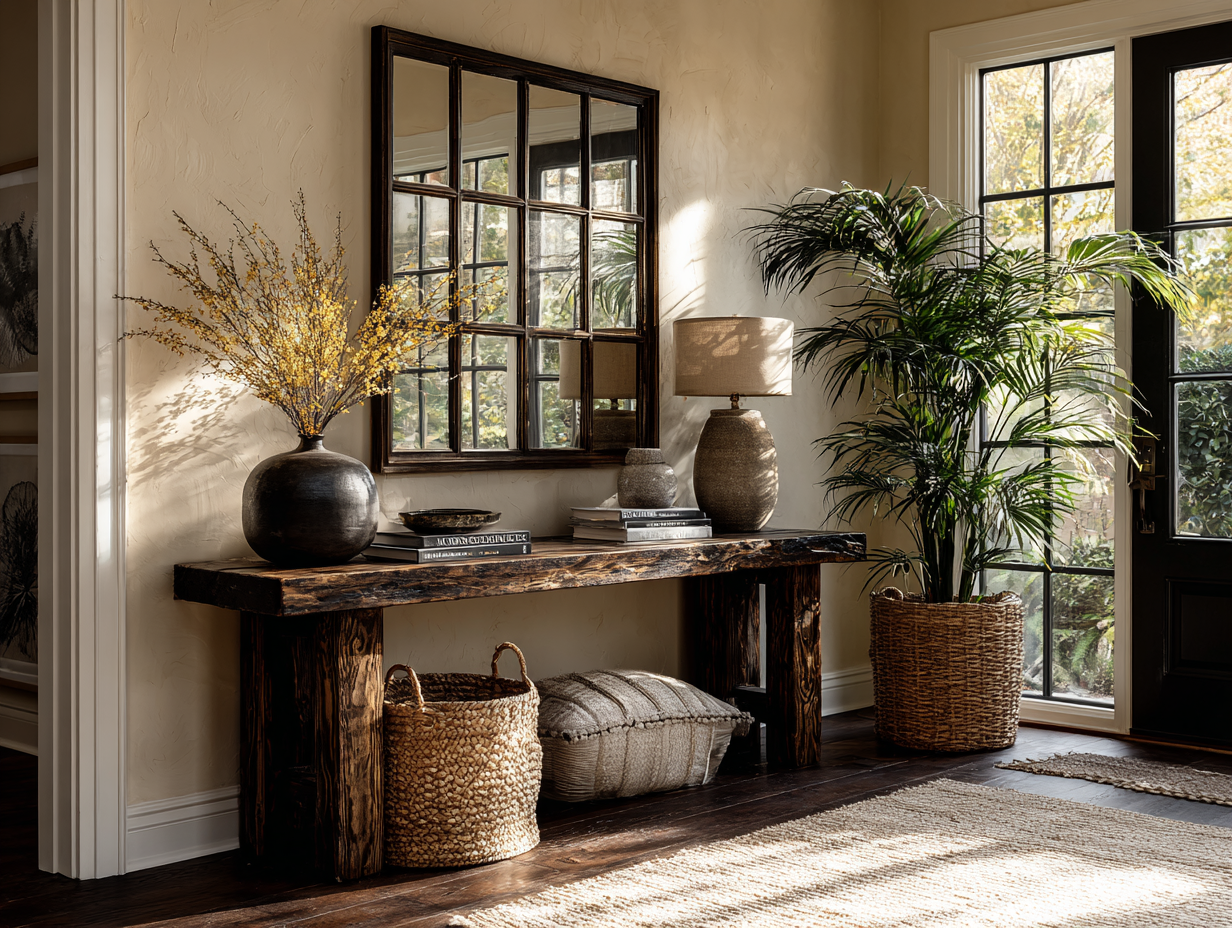
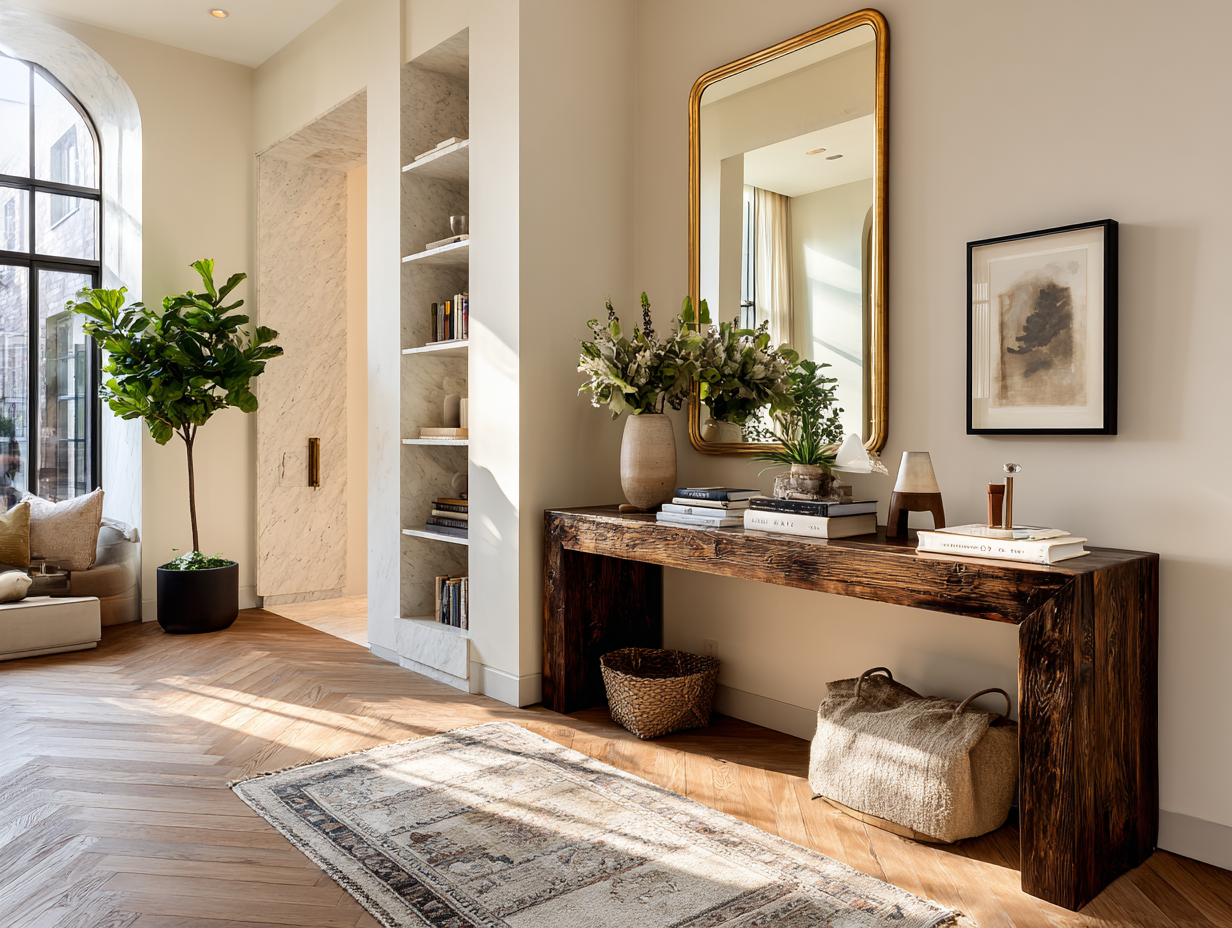
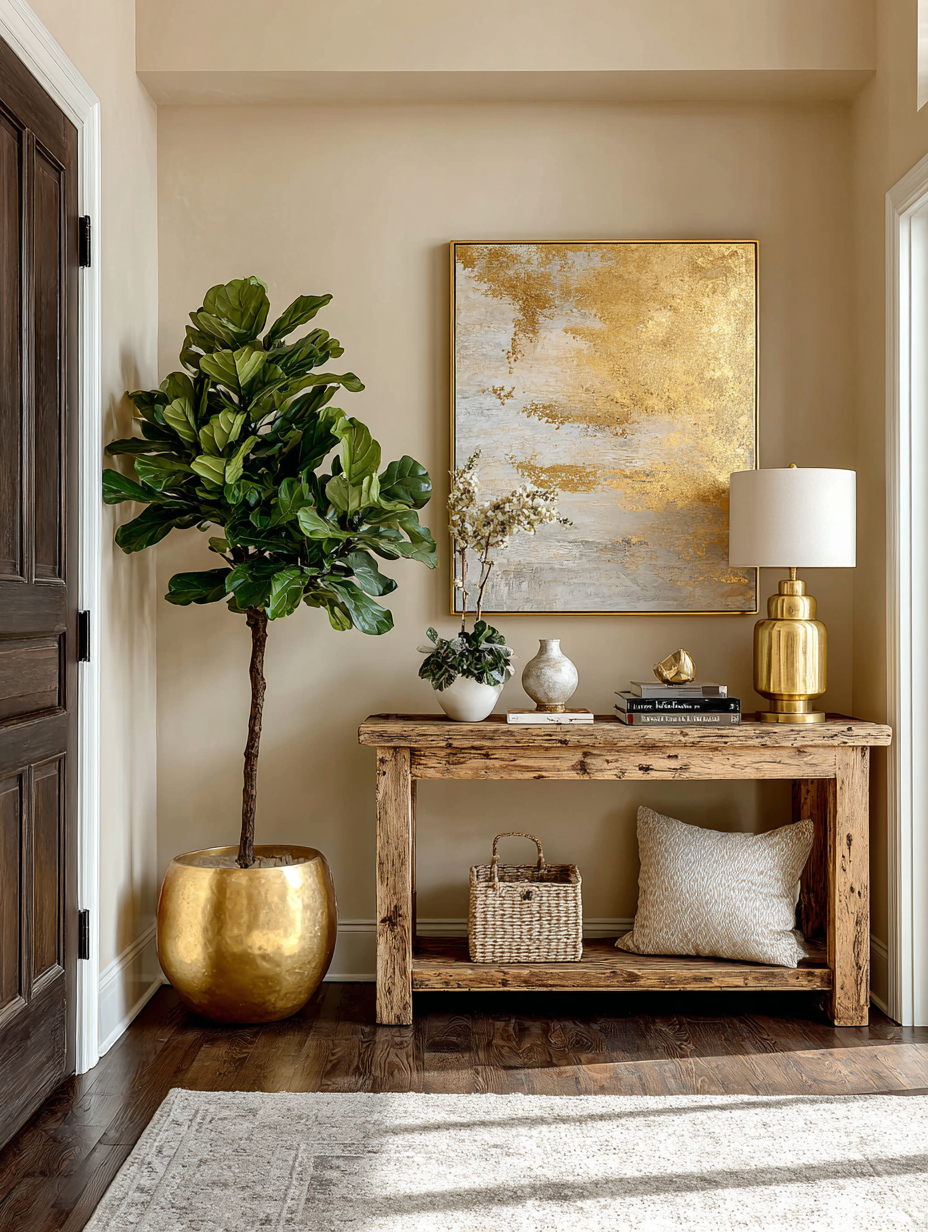
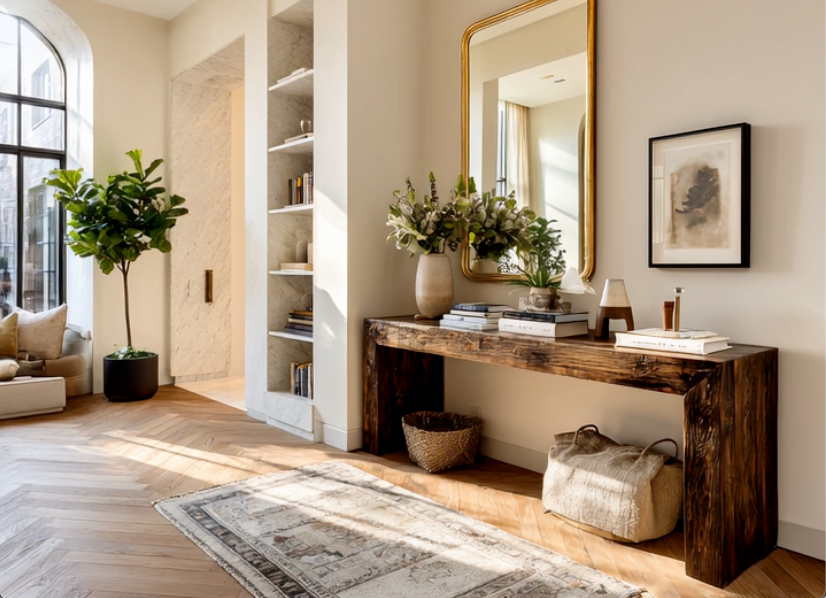
If you have a console table in the foyer, it becomes the heart of the entryway styling. Ours follows a simple composition we return to every year: something tall, something glowing, and something natural.
The tall element is usually a pair of brass taper candle holders in different heights, or a single elegant branch arrangement in a heavy vase. The glowing element is a cluster of pillar candles — ivory or beeswax tones, never scented here, because the foyer already carries the scent of the wreath and we do not want competing fragrances. The natural element is a low bowl: brass or wood, filled with pinecones, a few gold ornaments, and sprigs of cedar.
Keep the surface breathing. A console styled edge-to-edge looks like a shop display; a console with three deliberate groupings and empty space between them looks like a home. We leave room for keys and mail, because an entryway still has to function — elegance that ignores real life never lasts past the first week.
Light Is the Real Decoration
Here is the secret we wish someone had told us years ago: in December, light matters more than objects. The days are short, guests arrive after dark, and a foyer lit only by an overhead fixture will swallow even the most beautiful styling.
We layer three levels of light. The overhead stays on a dimmer, turned low. A table lamp with a warm bulb — or a pair of lanterns with real candles — provides the middle glow. And the fairy lights in the garland plus the candle cluster give the sparkle. Everything warm white, everything dimmable where possible. When the door opens on a cold night and that layered warmth spills out, it is the single most welcoming thing a house can do.
One safety note we never skip: real candles only where they can be seen and supervised, and always extinguished before bed. Battery-operated pillar candles with a realistic flicker have become genuinely good, and we use them without apology in the garland and on high shelves.
Scent, the Invisible Styling
Guests will forget your ornaments, but they will remember how your home smelled. We keep the foyer scent natural and simple: the fresh wreath does most of the work. On evenings when we are expecting people, we simmer a small pot on the stove — water, orange slices, a handful of cloves, a cinnamon stick, and a sprig of pine. Within twenty minutes the whole entryway smells like the holidays without a single synthetic fragrance.
We avoid plug-in air fresheners and strong scented candles in the foyer entirely. The goal is a whisper of pine and spice that people notice only as a feeling of warmth, not a perfume they can name.
What We Skip Every Year
Editing is the difference between festive and frantic, so here is our annual not-list. No inflatable or oversized figures crowding the porch — one beautiful wreath outperforms a whole cast of characters. No tinsel, which reads as chaos in a small space. No more than one patterned textile; if the ribbon is velvet, the throw on the bench stays solid. And no decorations that block the path — an entryway must still welcome boots, bags, and umbrellas gracefully.
We also skip the urge to match the entryway exactly to the living room tree. Cohesion does not mean identical. As long as the palette family is the same, each room can have its own mood — the foyer calm and glowing, the living room a little more celebratory.
The 30-Minute Entryway Formula
If you do nothing else, do this, in this order. Hang the wreath. Lay the garland with lights. Set out the candle cluster on the console. Fill the bowl with natural textures. Dim the overhead and light the candles. Simmer the pot. Step outside, close the door, and walk back in as a guest would. Adjust one thing — there is always one thing — and you are done.
An elegant Christmas entryway is not about having more. It is about choosing less, choosing warmly, and letting candlelight do the heavy lifting. When the door opens this December, let your home say exactly what you mean: come in, slow down, stay a while.